


Are you feeling uneasy about being unsteady? You are not alone. In America, the cost of falling down is estimated at 80 BILLION dollars a year. From bumps and bruises to fractures and unwanted surgeries, all can be the result of fighting with gravity and losing.
Your body has three main ways it keeps itself upright:
- Visual System – most people rely heavily on what their eyes are telling them to stay balanced. A common tip when trying to keep balance in tricky positions is to pick a reference point. Keep your focus on that point. This allows your brain to be aware if you are moving relative to that reference. Your brain will help you adjust accordingly.
- Vestibular System – within your inner ear space is a very complicated and sophisticated system of sensory organs. They detect acceleration and deceleration of your head. Your brain uses this information to orient itself. Dizziness after quick movements of the head or when looking up overhead are commonly caused by your vestibular system.
- Proprioceptive System– within the joints of your body you have joint receptors which help to signal to your brain where your joints are in space. As your joints move throughout their available ranges of motion, this information is being constantly transmitted to your brain to let it know what position you are in. If your brain determines your joints are not in their optimal position to maintain balance, your muscles will work to correct this.
As we age, all of the above systems begin to slow down in their ability to keep you upright. The good news is you can fight back against aging!
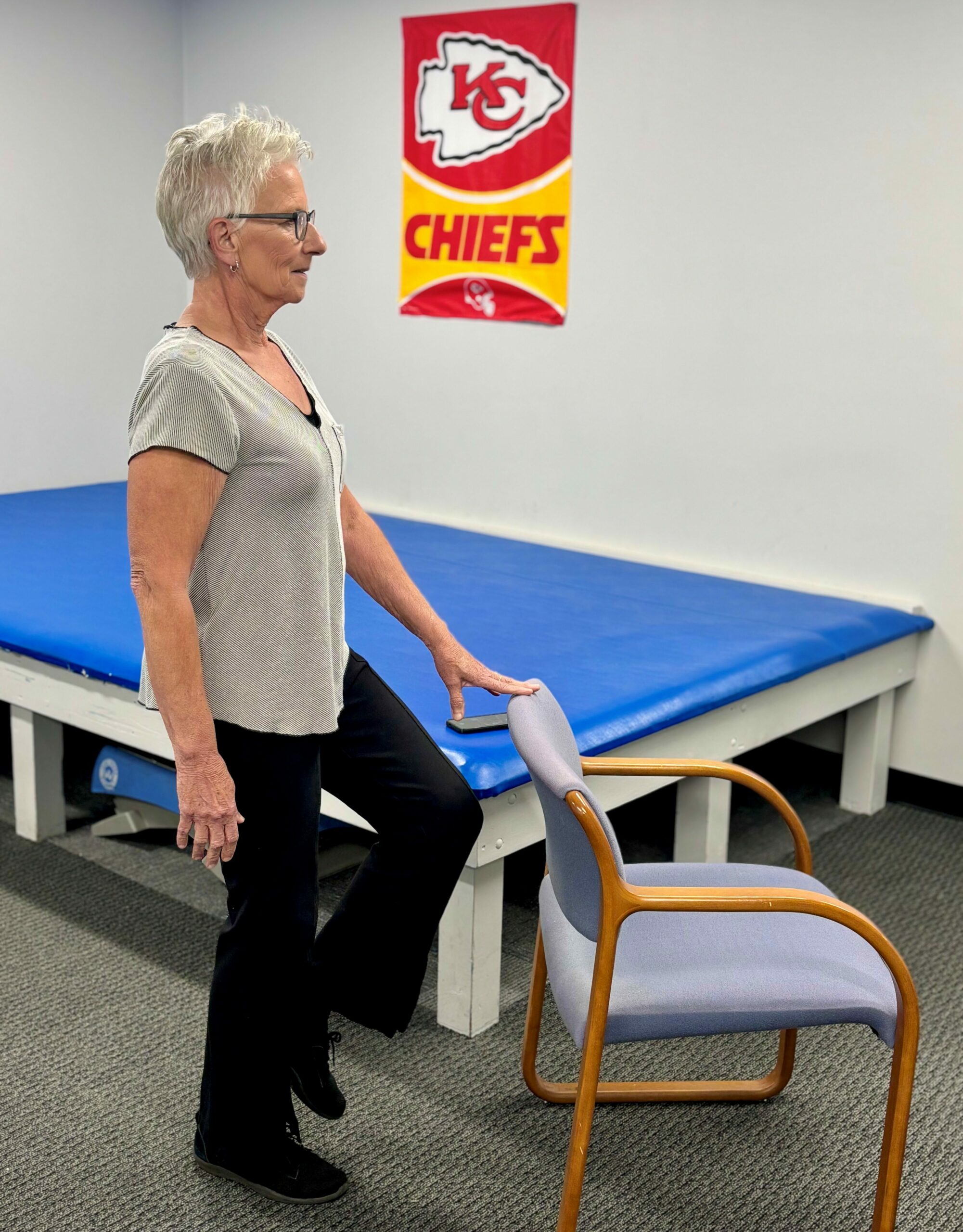
Follow these two simple exercises to help improve balance and prevent future falls.
- Feet together eyes open/closed – stand with your feet side by side (or one foot in front of the other for difficult mode), close your eyes fully. The objective is to see if you can keep your balance for more than 30 seconds. Your body will rely only on its vestibular and proprioceptive systems to tell you if you’re keeping upright. Again, be sure to be near a stable object you can grab for support if needed.
- Single leg balance – standing on one foot is an excellent way to train your lower extremity’s balance. Pick one foot off the ground (don’t loop it around your other leg!). Try to maintain an upright position for at least 30 seconds. If you are unable to do this, it is time to get to work! Practice near a stable object, such as the kitchen counter or a sturdy chair, so you have something to grab onto if necessary.
Give these exercises a try and see how you do! Balance is something that is “use it or lose it”. We recommend practicing balance exercises every single day to help reduce your risk of a future fall.
If you’ve had falls recently, or feel like your balance is getting worse, we would love to help! Call Summit Strength Physical Therapy at 816-524-7040 to schedule your appointment. Contact Summit Strength Physical Therapy – Summit Strength Physical Therapy

 800 NW Main St, Lee’s Summit, MO 64086
 info@summitstrength.com
 816-524-7040